Published July 12, 2026
China’s defense industry has spent the past several years quietly converting commercial robotics and AI breakthroughs into battlefield hardware. Beijing calls the doctrine “intelligentized warfare” — using AI, robotics, and unmanned systems to compress decision-making and strike faster than adversaries can respond, according to the Foundation for Defense of Democracies. Here are the ten systems drawing the most attention from defense analysts.
1. PF-070 armed robot dog
Unveiled at the World Defense Show 2026 in Riyadh, the PF-070 is a four-legged combat robot armed with four anti-tank guided missiles, built on a low-profile, “acoustically quiet” chassis that can reportedly engage targets up to four kilometers away. Forbes reports it’s already being marketed as a “production-ready platform” for international sale, not just a prototype.
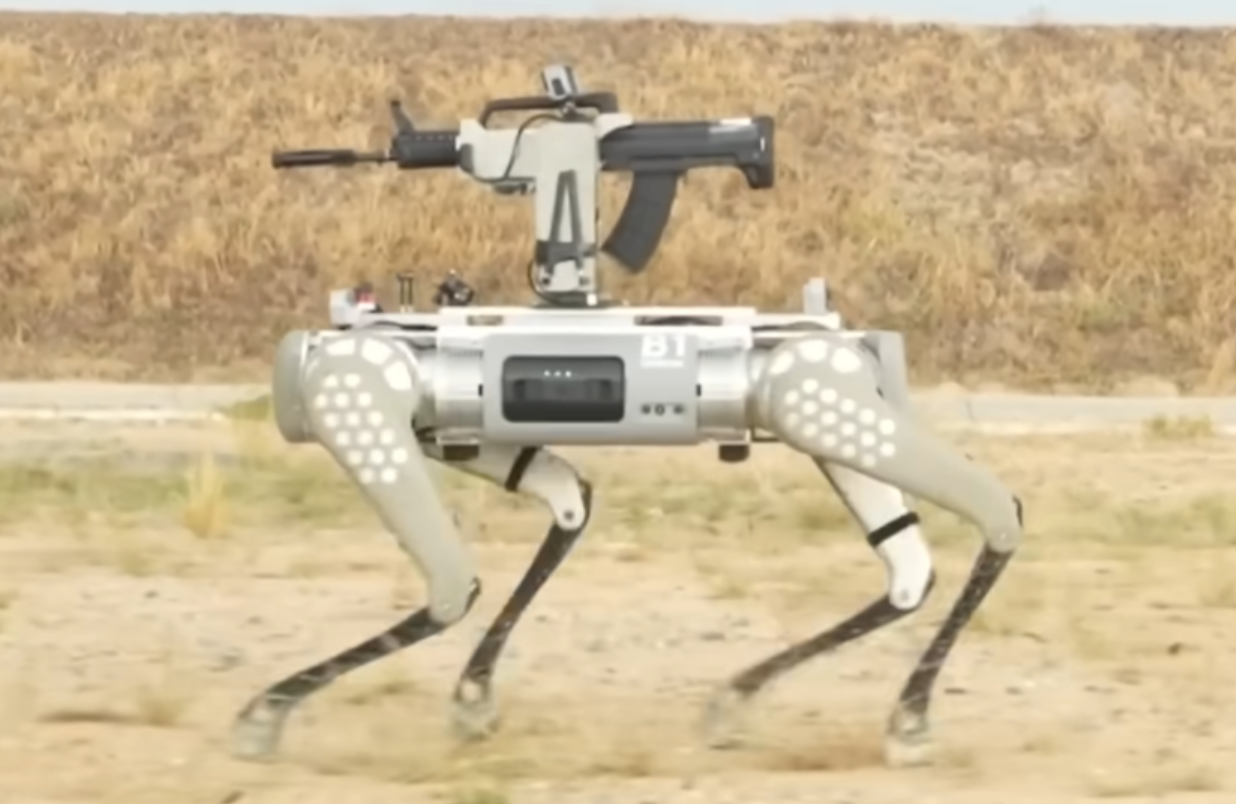
2. “Robot wolves” — Unitree-derived quadrupeds
Chinese state media has shown Unitree Robotics’ commercial quadrupeds converted into armed units carrying machine guns in breach-and-clear drills, airdropped onto rooftops from multi-rotor drones, and tested in urban combat simulations. FDD’s analysis describes them as networked “wolf packs” designed to scout, breach, and transport supplies alongside infantry, not standalone units.
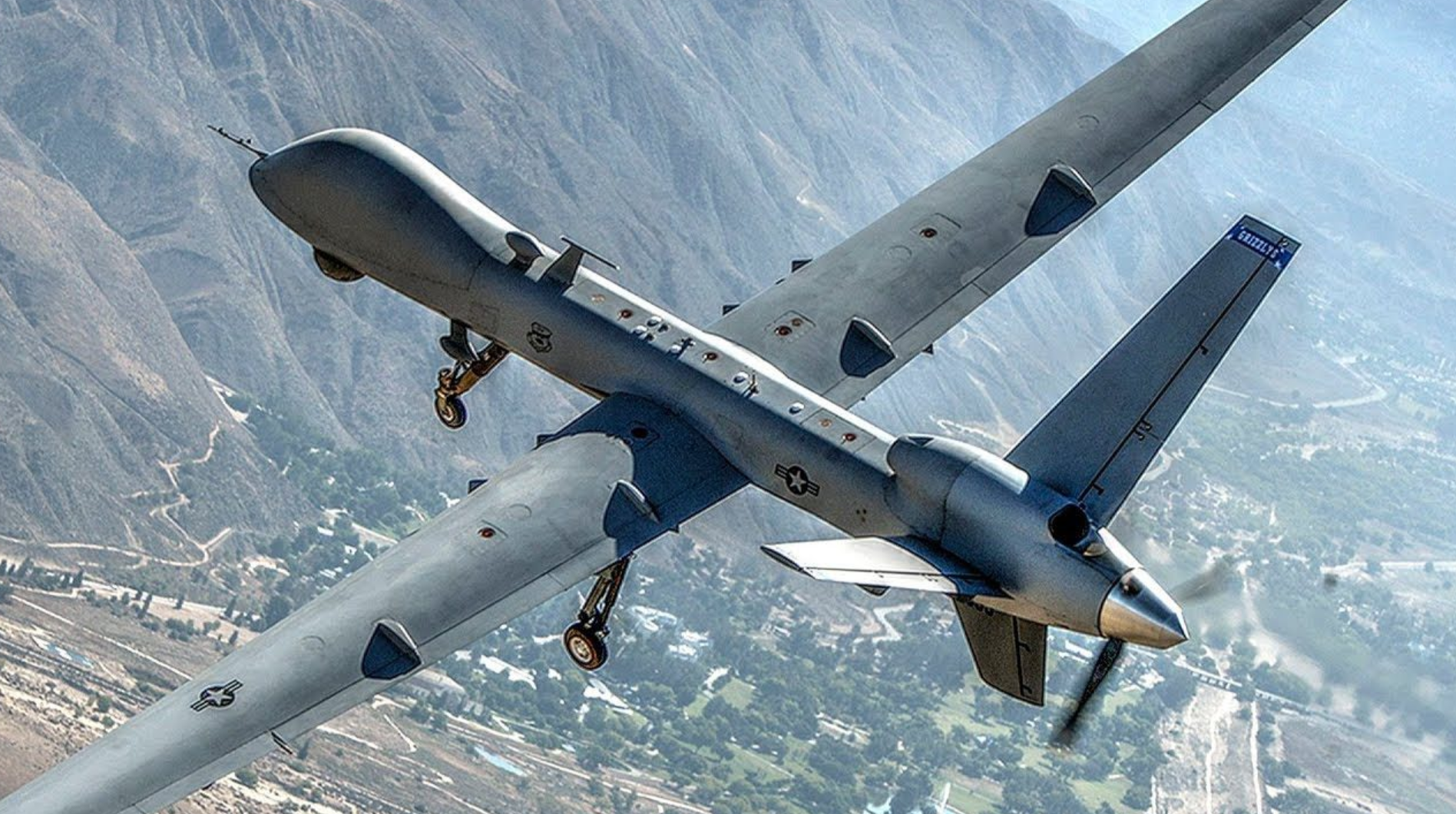
3. GJ-11 Sharp Sword
China’s stealth unmanned combat aerial vehicle (UCAV), reportedly one of the drones planned to operate from the Type 076 assault carrier’s flight deck, based on a CG simulation China’s aviation industry released at the Zhuhai Airshow, per Eurasian Times.
4. Zhu Hai Yun autonomous drone mothership
Billed as the world’s first AI-powered seaborne drone carrier, the Zhu Hai Yun can deploy more than 50 aerial, surface, and underwater drones to conduct three-dimensional reconnaissance across nearly 100 miles, per Kharon’s investigation into the vessel’s military ties. It circumnavigated Taiwan in an unusual route in late 2023 despite China describing it as purely civilian research, according to CSIS.
5. Type 076 Sichuan-class drone carrier
A PLA Navy officer confirmed this newly launched amphibious assault ship will operate uncrewed aerial vehicles, effectively making it a dedicated drone carrier for the fleet — a designation Wikipedia’s drone carrier overview notes was a first for a PLAN official to state on record.
6. AI-assisted guided missile frigate
The PLA demonstrated an AI-assisted decision-making system in 2025 that measurably improved the stealth profile of a guided missile frigate in real time, according to Euronews’ reporting on China’s military AI push.
7. Mass-produced drone swarms
China’s manufacturing base — which installed roughly 295,000 new industrial robots in 2024 alone versus 34,200 in the US, per the International Federation of Robotics figures cited by eWeek — lets it field large coordinated drone swarms relatively cheaply. Analysts at the Asia-Pacific Leadership Network note these swarms are partly a low-risk way to visibly demonstrate capability.
8. AI-driven electronic warfare jamming
Under China’s “AI Plus” strategy, researchers are reportedly using AI to predict how to jam enemy drones up to 5,000 kilometers away without relying on satellites — useful during solar storms or in a contested electronic environment — per South China Morning Post reporting relayed by Euronews.
9. Unmanned ship swarms
Yunzhou Tech, the manufacturer that helped design the Zhu Hai Yun, has developed “cooperative confrontation” software letting unmanned surface vessels autonomously track, intercept, and “besiege and expel” enemy ships as a coordinated swarm — demonstrated with 56 unmanned boats operating in formation, according to Defense.info’s analysis.
10. AI command-and-control (“digital staff officers”)
PLA doctrine, described in PLA Daily articles reviewed by FDD, envisions AI systems that take a commander’s stated intent and autonomously assign and coordinate battlefield tasks in real time — with some reporting suggesting China may integrate large language models, potentially including DeepSeek, into these systems, per Euronews.
The caveat that matters
Brookings’ review of Chinese military AI programs stresses that the maturity of these systems can’t be assessed with high confidence from open-source information, and most publicly shown platforms still keep a human in the loop on lethal decisions — genuine full autonomy remains unconfirmed. What is confirmed is the pace: China’s industrial scale means that whatever does work can be manufactured and fielded in volume faster than most competitors can match.
Sources: Forbes, FDD, Eurasian Times, Kharon, CSIS, Wikipedia, Euronews, eWeek, Brookings.